
Best email APIs for developers in 2026
Updated:
Mailtrap and Resend are the best email APIs for most apps in 2026. Mailtrap scores 80 of 100 and costs $30 for 100,000 emails, the lowest price on this list after Amazon SES, and its SDKs switch between a test sandbox and live sending with one flag. Resend scores 80 of 100, opens production access at signup and costs $20 a month for up to 50,000 emails. Bird Email (formerly SparkPost) scores 78 of 100 and gives you US and EU API hosts, with SMS on the same balance.
Amazon SES is the cheapest at volume, $10 for 100,000 emails, if you can wait for production access and route events through AWS. Mailgun (77 of 100) is the pick when your app also receives email or must keep message data in the EU.
 How we picked
We kept the full records that give a developer everything needed to build and test sending from an app: official SDKs in at least three languages, event webhooks, inbound email processing, a documented test mode, and an official MCP server or CLI. Ten services pass, ordered by our score out of 100, which gives 15 points to developer experience. Ties are listed alphabetically. The method is on how we rate.
SendPulse, SMTP2GO and Zoho ZeptoMail (now part of Zoho CPaaS) miss the cut because they have no inbound email, Elastic Email and MailerSend because they document no test mode, Loops because it documents no inbound email, and SocketLabs because we found no MCP server or CLI. All of them are on our main list of transactional email services.
The APIs compared
 Mailtrap |
80of 100 | $15Basic 10,000 | $30Basic 100,000 | 4,000 a month (150 a day) | Yes | Rated 2.8 out of 52.812 reviews (opens in a new tab) |
|---|---|---|---|---|---|---|
 Resend |
80of 100 | $20Pro 50,000 | $35Pro 100,000 | 3,000 a month (100 a day) | Yes | Rated 2.5 out of 52.523 reviews (opens in a new tab) |
 Bird Email |
78of 100 | $15Email Startup | $40Email Startup | 1,000 a month (50 a day) | Yes | Rated 1.6 out of 51.623 reviews (opens in a new tab) |
 Mailgun |
77of 100 | $15Basic 10k | $75Foundation 100k | 100 a day | Yes | Rated 4.1 out of 54.11,555 reviews (opens in a new tab) |
 Brevo |
74of 100 | $17Starter 10,000 | $82Starter 100,000 | 9,000 a month (300 a day) | Yes | Rated 3.8 out of 53.87,263 reviews (opens in a new tab) |
 Mailchimp Transactional |
74of 100 | $201 block | $804 blocks | 500 one-time | Yes | Rated 2.5 out of 52.51,565 reviews (opens in a new tab) |
 Mailjet |
72of 100 | $19Essential 15k | $112Premium 100k | 6,000 a month (200 a day) | Yes | Rated 4.0 out of 54.04,042 reviews (opens in a new tab) |
 Twilio SendGrid |
72of 100 | $19.95Essentials 50k | $34.95Essentials 100k | Trial, 60 days | No | Rated 1.1 out of 51.1615 reviews (opens in a new tab) |
 Amazon SES |
66of 100 | $1À la carte | $10À la carte | One-time credit | No | Rated 1.2 out of 51.2439 reviews (opens in a new tab) |
 Postmark |
64of 100 | $15Basic 10,000 | $115Basic 125,000 | 100 a month | Yes | Rated 1.8 out of 51.850 reviews (opens in a new tab) |
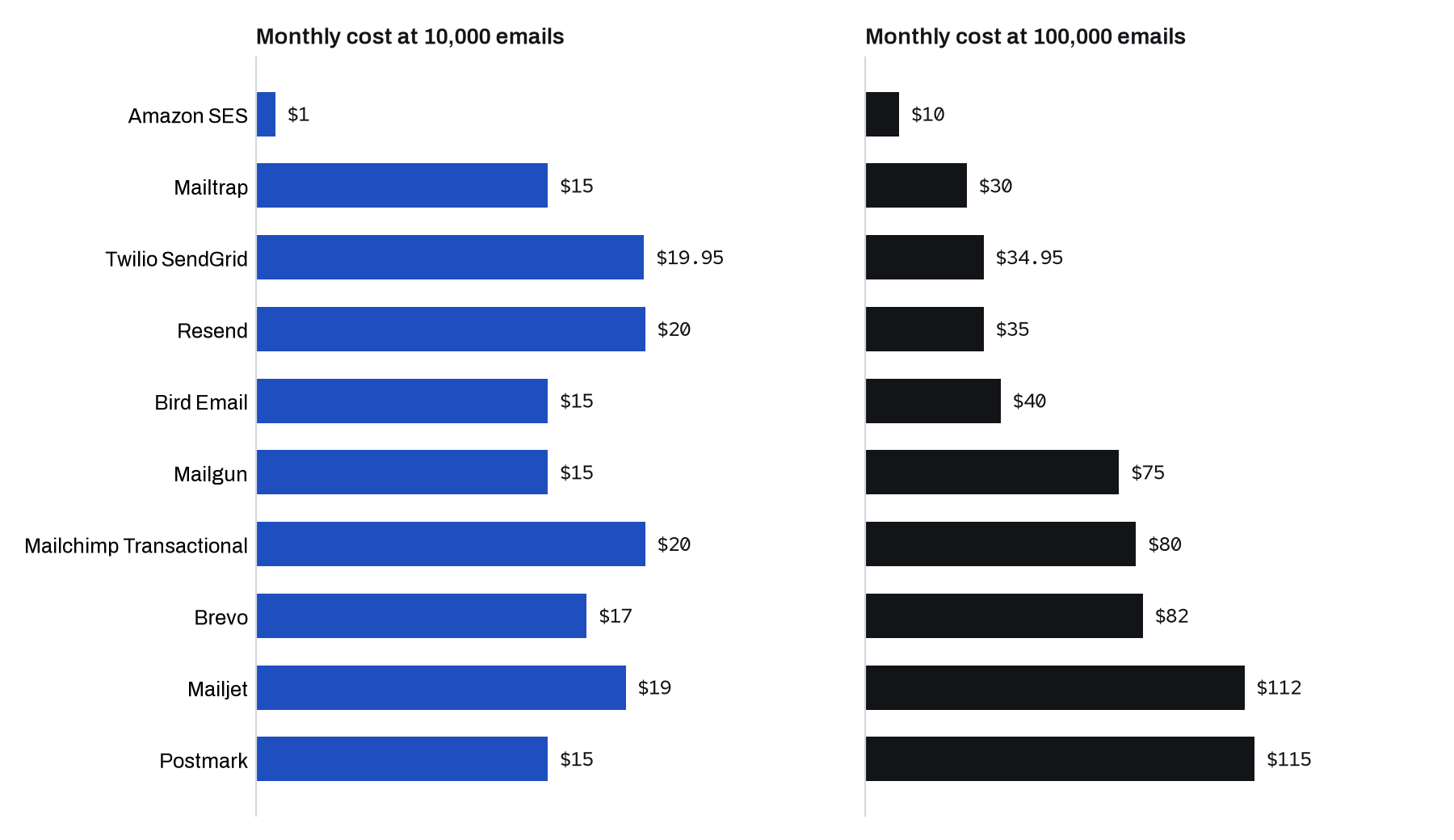
 How much does each email API cost?
At 10,000 emails a month, Amazon SES costs $1, Postmark $15, Mailgun $15, Brevo $17, SendGrid $19.95 and Resend $20. At 100,000 emails the order changes: SES costs $10, SendGrid $34.95, Resend $35, Mailgun $75, Brevo $82 and Postmark $115. SES charges per email with no monthly fee, and the others sell monthly tiers.
Free tiers differ more than paid ones. Resend’s 3,000 emails a month and Brevo’s 300 a day are permanent, Mailgun lists 100 a day with no end date, and Postmark gives 100 a month for testing. SendGrid offers a 60-day trial at 100 a day, and SES gives new AWS customers up to $200 in credits instead of free emails. New SES accounts also start on the Essentials plan at $0.16 per 1,000 emails until they cancel it. Our cost calculator prices other volumes.
 1. Mailtrap
Best for: Testing in a sandbox before sending live
- Score
- 80 of 100
- 10,000 emails
- $15
- 100,000 emails
- $30
- Free plan
- 4,000 a month (150 a day)
- Trustpilot
- Rated 2.8 out of 52.812 reviews (opens in a new tab)
Mailtrap’s official SDKs cover 8 languages, including Go and Elixir, and switch between the Email Sandbox and live sending with one flag. The batch endpoint sends up to 500 messages per call, the API allows 150 requests per 10 seconds per token, and Mailtrap publishes an MCP server and a CLI with about 135 commands. Basic costs $15 for 10,000 emails, with webhooks, templates and inbound email on the same quota. Watch two things: the sandbox beyond 50 test emails a month is a separate subscription, and the send endpoint has no scheduling field. Email logs are kept 5 days on Basic.
 2. Resend
Best for: Next.js and Node.js apps that need to ship today
- Score
- 80 of 100
- 10,000 emails
- $20
- 100,000 emails
- $35
- Free plan
- 3,000 a month (100 a day)
- Trustpilot
- Rated 2.5 out of 52.523 reviews (opens in a new tab)
Resend is built for code-first teams. Accounts get production access at signup, the batch API takes up to 100 emails per call, emails can be scheduled up to 30 days ahead, and inbound mail on a verified domain is posted to a webhook. A remote MCP server, a CLI and an OpenAPI spec cover AI coding tools, and official SDKs span 8 languages plus Laravel. The free plan sends 3,000 emails a month, and Pro costs $35 for 100,000. Watch the rate limit of 10 requests per second per team with no burst. There is no separate test key or sandbox, and test addresses such as delivered@resend.dev count against your quota.
 3. Bird Email
Best for: Apps that also send SMS or WhatsApp
- Score
- 78 of 100
- 10,000 emails
- $15
- 100,000 emails
- $40
- Free plan
- 1,000 a month (50 a day)
- Trustpilot
- Rated 1.6 out of 51.623 reviews (opens in a new tab)
Bird Email has regional API and SMTP hosts in the US and the EU, an OpenAPI 3.1 spec, SDKs for TypeScript, Python, Go and PHP, and idempotency keys. Its mail sandbox sends to magic addresses that run through the real event and webhook pipeline without delivering. A hosted MCP server and a CLI that can create an account from the terminal round it out. Pricing is per email from a monthly deposit, $40 at 100,000 emails. Watch the rate limits: the Startup plan allows 30 Send API calls and 10 batch calls a minute. Code written for the old SparkPost API needs changes, since Bird Email has its own API, SDKs and credentials.
 4. Mailgun
Best for: Apps that receive and route inbound email
- Score
- 77 of 100
- 10,000 emails
- $15
- 100,000 emails
- $75
- Free plan
- 100 a day
- Trustpilot
- Rated 4.1 out of 54.11,555 reviews (opens in a new tab)
Mailgun’s inbound Routes match incoming mail and forward it to your app, and batch sends reach up to 1,000 recipients per call with recipient variables. The API runs in US or EU regions with an OpenAPI 3.1 spec, SDKs in 6 languages and a local MCP server with more than 50 operations. Basic costs $15 for 10,000 emails. Watch the entry plan: Basic keeps 1 day of logs, allows 1 API key and 5 inbound routes, and full route access starts on Foundation. Messages sent with o:testmode are not delivered but are still charged.
 5. Brevo
Best for: Teams that send marketing and app email from one API
- Score
- 74 of 100
- 10,000 emails
- $17
- 100,000 emails
- $82
- Free plan
- 9,000 a month (300 a day)
- Trustpilot
- Rated 3.8 out of 53.87,263 reviews (opens in a new tab)
Brevo’s transactional endpoint allows 1,000 requests per second on general limits, and the batch endpoint sends up to 1,000 message versions per request with idempotency keys. The X-Sib-Sandbox: drop header validates calls without sending or logging, and SDKs cover 7 languages. An account MCP server lets agents work with your Brevo data. The free plan sends 300 emails a day, and Starter costs $17 for 10,000. Watch the account approval before your first send, the hard stop at the monthly quota on paid plans, and scheduled sending, which is still in public beta.
 6. Mailchimp Transactional
Best for: Marketers who edit templates that developers send
- Score
- 74 of 100
- 10,000 emails
- $20
- 100,000 emails
- $80
- Free plan
- 500 one-time
- Trustpilot
- Rated 2.5 out of 52.51,565 reviews (opens in a new tab)
Mailchimp Transactional, formerly Mandrill, gives you test API keys that send nothing, do not count toward your sends and allow up to 10,000 test messages a day. Scheduling reaches one year ahead, a rules engine changes sending behavior on conditions, and a first-party MCP server can call the API. One block of 25,000 emails costs $20, plus the paid Mailchimp Standard or higher plan it requires, billed separately. Watch the SDKs, which cover only Node.js, PHP, Ruby and Python, and the 30 days of stored email content.
Mailchimp Transactional reviewPricing page (opens in a new tab)
 7. Mailjet
Best for: EU-hosted apps that also send newsletters
- Score
- 72 of 100
- 10,000 emails
- $19
- 100,000 emails
- $112
- Free plan
- 6,000 a month (200 a day)
- Trustpilot
- Rated 4.0 out of 54.04,042 reviews (opens in a new tab)
Mailjet’s Send API v3.1 takes up to 50 messages per call, and its SandboxMode validates a payload without delivering. SDKs cover 7 languages, and OpenAPI 3 files are published. Data is stored only in EU data centers. Essential costs $19 for up to 15,000 emails. Watch the inbound Parse API, which needs Premium 50k or higher, the API rate limit, which is not published, and scheduling, which is documented for campaign drafts and not for Send API messages. The official MCP server is local and read-only, so it can read account data but cannot send.
 8. Twilio SendGrid
Best for: High request rates and teams already on Twilio
- Score
- 72 of 100
- 10,000 emails
- $19.95
- 100,000 emails
- $34.95
- Free plan
- Trial, 60 days
- Trustpilot
- Rated 1.1 out of 51.1615 reviews (opens in a new tab)
Twilio SendGrid’s Mail Send API accepts up to 10,000 requests per second, each with up to 1,000 recipients, and sandbox_mode validates a request without sending or using credits. Dynamic templates use Handlebars, Inbound Parse posts incoming mail to your endpoint, and SDKs cover 7 languages. The Twilio CLI can send email, but SendGrid has no official MCP server for sending. Essentials costs $19.95 at 10,000 emails. Watch the trial: new accounts get 60 days at 100 emails a day, integrations stop sending when it ends, and Essentials keeps 3 days of activity.
 9. Amazon SES
Best for: High-volume apps already on AWS
- Score
- 66 of 100
- 10,000 emails
- $1
- 100,000 emails
- $10
- Free plan
- One-time credit
- Trustpilot
- Rated 1.2 out of 51.2439 reviews (opens in a new tab)
Amazon SES is called through the AWS SDKs, which cover 13 languages from Python and JavaScript to Rust and Swift, or through the AWS CLI. It costs $10 for 100,000 emails at the à la carte rate, and tenants keep each customer’s identities, reputation and suppression list apart inside one account. Watch the wiring: there is no direct HTTP webhook, so events go to SNS, EventBridge, Firehose or CloudWatch. The mailbox simulator works in the sandbox but is billed like normal email, and AWS’s own MCP server is a sample it does not recommend for production.
 10. Postmark
Best for: Transactional email kept apart from bulk sends
- Score
- 64 of 100
- 10,000 emails
- $15
- 100,000 emails
- $115
- Free plan
- 100 a month
- Trustpilot
- Rated 1.8 out of 51.850 reviews (opens in a new tab)
Postmark’s API takes batches of up to 500 messages and 50 MB per request, and the POSTMARK_API_TEST token validates requests without delivering. Official libraries cover Node.js, Python, Ruby, .NET, Java and PHP, and a local MCP server with 24 tools adds delivery diagnostics. Inbound processing posts JSON to a webhook on Pro, from $16.50 for 10,000 emails. Watch the gaps: no numeric rate limit is published, scheduled sending is not supported, and support is email only during business hours, with replies typically within a few business hours.
How fast can you send your first email?
Resend is the quickest: every account gets production access at signup with no review or sandbox, and Bird Email documents no upfront approval either. Mailgun starts each account with a sandbox domain that sends to up to 5 authorized recipients, Postmark reviews every account by hand in under 24 hours on weekdays, and Amazon SES starts in a sandbox of 200 emails a day, with a first response to production requests within 96 hours.
| Service | Before full sending | Testing without real delivery |
|---|---|---|
| Mailtrap | Each domain gets a compliance check, usually automatic within minutes | Email Sandbox, a separate product with 50 free test emails a month |
| Resend | No review, production access at signup | Test addresses such as bounced@resend.dev, counted against the quota |
| Bird Email | No approval documented, and before domain verification mail goes only to workspace members and sandbox addresses | Magic addresses at messagebird.dev that trigger real events |
| Mailgun | Sandbox domain with 5 authorized recipients | o:testmode, charged like normal mail |
| Twilio SendGrid | Single Sender check on the trial, limits lifted after verification steps | sandbox_mode, no credits used |
| Brevo | Account approval before sending | X-Sib-Sandbox: drop header |
| Mailchimp Transactional | Paid Mailchimp Standard plan and a verified domain | Test API keys, up to 10,000 messages a day |
| Mailjet | Not documented | SandboxMode in Send API v3.1 |
| Amazon SES | Sandbox of 200 emails a day until production access | Mailbox simulator, billed like normal email |
| Postmark | Manual review, under 24 hours on weekdays | POSTMARK_API_TEST token |
 Which email APIs have webhooks, inbound email and idempotency?
All ten report delivery events and parse inbound email, but the plumbing differs. Amazon SES has no direct HTTP webhook, so events go through SNS, EventBridge, Firehose or CloudWatch. Inbound needs Postmark Pro or Mailjet Premium 50k, while Mailtrap, Bird Email and Resend include it on every plan. Bird Email supports idempotency keys, and Brevo’s batch endpoint takes them with a 30-minute lifetime.
Limits vary by plan. SendGrid allows 1 event webhook on the trial, 2 on Essentials and 5 on Pro. Mailgun gives 1 inbound route on Free and 5 on Basic, with full access from Foundation. Resend and Mailtrap count received emails toward the monthly quota, and Resend accepts a Resend-Idempotency-Key header on SMTP sends. If you only need to send, our SMTP relay ranking covers services without inbound.
Which to choose
- You want to send from a new app today. Resend opens production access at signup and sends 3,000 emails a month free. See the Resend review.
- You send more than 100,000 emails a month on AWS. Amazon SES costs $100 for 1,000,000 emails at the à la carte rate. See the Amazon SES review.
- Your app receives replies or support mail. Mailgun routes inbound mail on every plan, with full route access from Foundation. See the Mailgun review.
- You want a test mode that never delivers. SendGrid’s
sandbox_modeuses no credits, and Postmark’s test token sends nothing. See SendGrid vs Postmark. - You need EU data. Mailgun’s EU region keeps message data in the EU, and Brevo and Mailjet host everything there. See the Brevo review.
- You are choosing between Resend and Postmark. Resend schedules sends and opens access at signup, while Postmark separates transactional and bulk streams. See Postmark vs Resend.
 Frequently asked questions
What is the best email API for developers in 2026?
By our score, Mailtrap and Resend lead the developer list in 2026, followed by Bird Email (formerly SparkPost), Mailgun and Brevo. Resend has the quickest start, with production access at signup, and Amazon SES has the lowest price at volume.
Which email API is the easiest to integrate?
Resend has the fewest steps before a real send: no account review, no sandbox and official SDKs for Node.js, Python, PHP and five more languages. Postmark reviews every new account by hand, and Amazon SES starts every account in a sandbox of 200 emails a day.
Which email APIs have a free plan?
Resend (3,000 emails a month), Mailtrap (4,000 a month), Mailjet (6,000 a month), Brevo (300 a day), Bird Email (1,000 a month), Mailgun (100 a day) and Postmark (100 a month) list free plans with no stated end date. SendGrid offers a 60-day trial, Amazon SES gives AWS credits instead of free emails, and Mailchimp Transactional has a one-time demo of 500 emails.
Is Amazon SES cheaper than SendGrid?
Yes, at every volume in our data, even on the Essentials plan that new AWS accounts start on. Twilio SendGrid includes 24/7 ticket and chat support on paid plans, while SES needs a paid AWS Support plan for technical help. See SendGrid vs Amazon SES for the full comparison.
Sources
Prices and features come from each vendor's own pages, and other facts from the pages listed here, read on the dates shown. Prices exclude sales tax.
- Mailtrap pricing (opens in a new tab), checked November 18, 2026
- Resend pricing (opens in a new tab), checked November 18, 2026
- Bird Email pricing (opens in a new tab), checked November 18, 2026
- Mailgun pricing (opens in a new tab), checked November 18, 2026
- Brevo pricing (opens in a new tab), checked November 18, 2026
- Mailchimp Transactional pricing (opens in a new tab), checked November 18, 2026
- Mailjet pricing (opens in a new tab), checked November 18, 2026
- Twilio SendGrid pricing (opens in a new tab), checked November 18, 2026
- Amazon SES pricing (opens in a new tab), checked November 18, 2026
- Postmark pricing (opens in a new tab), checked November 18, 2026